

Apple’s China Engagement Highlights the Importance of Its Global Market Strategy
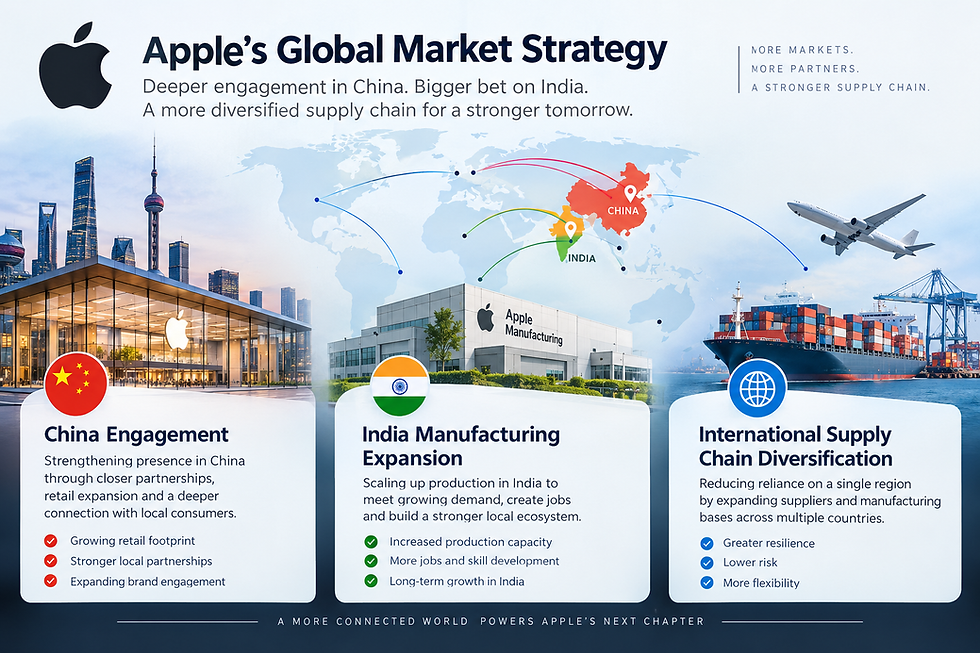
Apple global market strategy
Apple’s continued engagement with China underscores the importance of maintaining strong relationships in key international markets while adapting to changing economic and geopolitical conditions. The technology giant’s latest visit to China by Executive Chairman Tim Cook highlights how global corporations must balance manufacturing efficiency, market expansion, supplier relationships, and long-term business resilience.
According to reports published in October 2026, Cook visited China for the third time this year and held discussions with officials in Guangdong about expanding Apple’s local presence, including smart manufacturing,
sales channels, and research and development. He also met Chinese Vice Premier He Lifeng in Beijing, reinforcing the importance of continued business engagement between Apple and China. (South China Morning Post, China’s State Council)
These developments offer an important lesson for business leaders: success in international markets requires more than selling products across borders. It depends on building lasting partnerships, understanding local market conditions, and developing a strategy that can respond to global change.
China Remains a Strategic Market for Apple
China has played a significant role in Apple’s global business for years, serving as both a major consumer market and a critical manufacturing hub. The country’s extensive supplier network, industrial infrastructure, skilled workforce, and manufacturing capabilities have helped Apple develop and produce products on a massive scale.
Apple’s engagement with Chinese officials and regional business leaders demonstrates that the company continues to see value in maintaining its presence in the country. Guangdong, in particular, is home to numerous suppliers and manufacturing partners connected to Apple’s operations.
For Apple, maintaining these relationships can support manufacturing efficiency, supplier coordination, product development, and access to consumers in one of the world’s largest technology markets.
However, the business environment is becoming increasingly complex. Domestic smartphone manufacturers, including Huawei, Xiaomi, Oppo, and Vivo, compete aggressively through pricing, product innovation, and customer engagement.
Recent market data also points to continuing challenges. Reuters reported on October 13, 2026, citing IDC, that smartphone shipments in China declined by 15.4% year over year in the third quarter, while Apple’s shipments fell by 4.3%. Huawei recorded growth and captured a 21% market share during the period. These figures illustrate the competitive pressures facing international technology brands in China. (Reuters)
Global Market Diversification Is Becoming Essential
One of the most important lessons from Apple’s strategy is that international expansion must be supported by diversification.
For many years, China has been central to Apple’s manufacturing operations. However, geopolitical tensions, trade restrictions, tariff uncertainty, and supply chain risks have encouraged the company to expand production in other countries.
India has become an increasingly important part of this strategy. Apple has been expanding its manufacturing presence there through contract manufacturers and local industrial partners. In April 2025, Reuters reported that Apple aimed to produce most of the iPhones sold in the United States in India by the end of 2026, reflecting its efforts to reduce exposure to potential trade barriers affecting China-based production.
This shift illustrates a broader change in global business strategy. Rather than relying heavily on one manufacturing location, multinational companies are exploring multiple production centres to improve flexibility and reduce concentration risk.
For Apple, the challenge is to diversify without losing the efficiency and supplier integration that helped establish its manufacturing capabilities in China.
The strategic objective is not necessarily to replace one market with another, but to build a more resilient global operating model.
Balancing Manufacturing Efficiency with Geopolitical Risk
Apple’s international operations highlight the close relationship between corporate strategy and geopolitics.
Trade disputes between major economies can affect production costs, product pricing, supplier decisions, and access to important markets. Regulatory changes may also influence how technology companies manage data, applications, manufacturing, and investment.
Maintaining relationships with government officials and regional business leaders can help multinational corporations understand local priorities and navigate changing business conditions. Cook’s recent discussions with Chinese officials demonstrate the continuing importance of such engagement.
At the same time, corporate leaders must avoid becoming overly dependent on political goodwill or a single country's industrial ecosystem. A well-designed global strategy needs contingency planning, alternative suppliers, diversified production capacity, and clear assessments of regulatory risk.
For business leaders, the broader message is straightforward: geopolitical risk management must be an integral part of corporate planning rather than a response to unexpected disruption.
India’s Growing Importance in Apple’s Global Strategy
Apple’s expanding manufacturing operations in India demonstrate the growing importance of emerging markets in global supply chain planning.
India offers a large domestic consumer market, a developing electronics manufacturing ecosystem, and opportunities for companies seeking to diversify production beyond China. Government initiatives supporting electronics manufacturing have also helped attract investment and strengthen the country's position in global technology supply chains.
For Apple, India represents an opportunity to expand production capacity while serving a growing base of consumers. For Indian businesses, the expansion can create opportunities across component manufacturing, logistics, industrial infrastructure, packaging, and supporting services.
Nevertheless, building a competitive manufacturing ecosystem requires sustained investment in skills, infrastructure, supplier quality, and operational efficiency. Replicating China's deeply integrated supplier network is a complex, long-term process.
India's opportunity therefore extends beyond assembling finished products. Developing a broader network of component suppliers, technology partners, and manufacturing specialists will be important for strengthening its role in global value chains.
Innovation and Local Competition Remain Critical
Global market strategy is not only about manufacturing locations. It also depends on how effectively a company responds to local consumers.
Apple's premium positioning, integrated hardware and software ecosystem, and emphasis on customer experience have helped distinguish its products internationally. However, these advantages do not eliminate the need to adapt to local market conditions.
In China, domestic competitors continue to challenge international brands with diverse product portfolios, aggressive pricing, and features tailored to local preferences. Market performance can also be affected by consumer spending, product launch cycles, and changing technology expectations.
Apple must therefore combine its global brand identity with a strong understanding of local competition. Product innovation, customer service, distribution partnerships, and pricing decisions will remain important to maintaining its position.
This principle applies to companies in every industry: a successful international strategy must balance global consistency with local responsiveness.
What Business Leaders Can Learn from Apple
Apple’s continued engagement with China offers several lessons for entrepreneurs, executives, and corporate decision-makers.
1. Diversify without abandoning valuable partnerships. Expanding into new markets can reduce risk, but established supplier relationships and operational capabilities remain valuable assets.
2. Build resilient supply chains. Companies should evaluate their dependence on individual suppliers, countries, and transportation routes. Alternative production options can improve their ability to respond to unexpected disruptions.
3. Treat geopolitical developments as business risks. Trade policies, regulatory changes, and international relations can influence profitability and long-term investment decisions.
4. Understand local consumers. A globally recognised brand still needs to respond to local competition, purchasing power, customer expectations, and market trends.
5. Invest for the long term. Establishing manufacturing capabilities, developing supplier networks, and building customer trust require consistent investment rather than short-term decisions.
6. Keep innovation at the centre of growth. Diversification can strengthen operations, but sustained competitiveness ultimately depends on delivering products and services that customers value.
The Road Ahead for Apple
Apple’s latest China engagement highlights the complexity of managing a global business in a rapidly changing economic environment. The company must preserve the advantages of its established Chinese operations while expanding manufacturing alternatives and responding to intensifying competition.
Its long-term performance will depend on how effectively it balances these priorities. Continued engagement with China may help maintain important commercial relationships, while greater production diversification can provide additional flexibility.
For investors and corporate observers, the situation also demonstrates why a company's international strategy should be assessed through several factors: market demand, competitive positioning, supplier resilience, regulatory exposure, and the ability to adapt to changing conditions.


Comments